
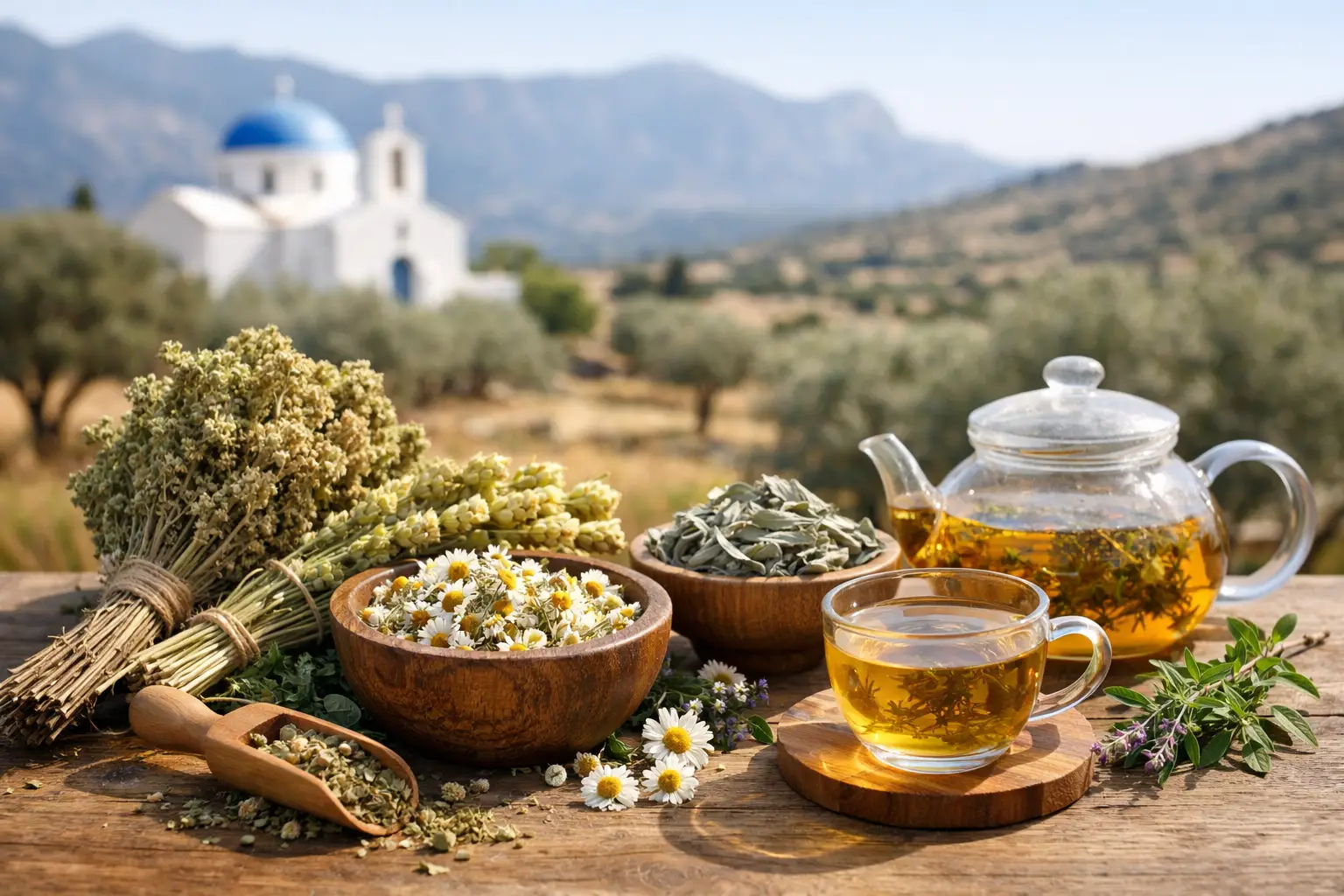
The first sip of Greek-produced herbs can convey much more than just taste. The coolness of a mountainside, the intensity of the Mediterranean sun, the subtle aromatic signature of a place that cannot be copied. When the origin is true and the raw material is treated with care, the concoction ceases to be an everyday habit. It becomes a small journey on the Greek map.
Why Greek production is changing the cup
Greece has a rare botanical geography. Mountains, islands, dry-thermal soils, clean air and large temperature swings create conditions that give plants a special aromatic character. Mountain tea, sage, verbena, chamomile and lemon balm are not just familiar names. They are plants tied to the landscape, memory and gastronomic culture of the place.
Their value, however, is not only in their origin. It is in the journey from the field to the cup. The time of collection, the method of drying, the protection of the aroma, the storage and the standardization determine whether the final beverage will have purity, duration and balance or whether it will leave a flat, vague impression.
That's why the phrase "Greek herb" needs content. A Greek name on the packaging is not enough. The essence lies in the cultivation or collection in Greece, in the traceability and in the respect for the raw material at every stage.
Greek-produced herbs: origin is not a detail
In the premium category, origin does not function as decorative information. It is an element of taste. A mountain tea with a pure Greek identity has its own mild, earthy and floral personality. Verbena can highlight its bright, lemony freshness. Sage offers its characteristic, gently resinous aroma, without becoming aggressive.
These subtle differences are often lost when a product relies on powders, artificial flavors, or minimal amounts of real extract. The result may be sweet and easy, but it rarely has depth. In contrast, a carefully crafted infusion lets the plant itself speak.
Choosing Greek production has another dimension: it brings the consumer closer to seasonality and natural variability. The harvest is not a lifeless, absolutely identical raw material. Each year has its own character. Quality, therefore, does not mean uniformity without a soul. It means constant care so that the character of the plant reaches the glass intact.
From the mountain to modern ritual
Mountain tea holds a special place in Greek everyday life. For generations, it has been brewed in teapots, in homes and mountain shelters, with that simple generosity that characterizes the most authentic habits. Today, its place can be just as natural on a modern breakfast table, in a creative office or in a hotel welcome ritual.
The aim is not to turn tradition into a nostalgic setting. It is to reread it, with modern criteria of quality and aesthetics. An herb of exceptional origin can be presented in biodegradable pyramid, to be served with precision or to form the basis for a premium herbal iced tea. Tradition does not lose its truth when it evolves. It loses it when it is replaced by a crude imitation.
At tea Odyssey, this transition is treated as a matter of care: Greek organic herbs, design that respects the experience, and recipes where the real extract plays a leading role. The difference is felt even before the sip, in the aroma rising from the cup or in the clean finish of a cold drink.
What distinguishes a quality brew?
Choosing a good herb doesn’t have to be complicated, but it does require some thought. The packaging should clearly state the plant and its origin. The image of the herb itself also matters: clearly visible leaves, flowers or stems usually allow for a more complete aromatic expression than an unknown, overly crushed blend.
Organic farming, when certified, is another essential criterion for those who choose consciously. It is not in itself a guarantee of taste excellence, nor is every selected herb organic. However, it is associated with a farming philosophy that is worth seeking out, especially when the purity of the raw material is at the center.
Packaging is also important. Essential oils from herbs are sensitive to light, moisture and air. A thoughtful solution protects the contents, while a biodegradable pyramid offers space for the leaves to grow in the water. This is not a technical detail. It is part of the tasting experience and a more responsible choice.
Hot or cold? The herb changes, it doesn't lose its identity
Greek herbs are not just for the winter months. A properly prepared infusion can be an excellent cold drink, with depth and coolness without relying on excessive sweetness. The process requires balance: enough extraction time to convey the character of the plant, but not so intense that bitter or woody notes dominate.
For a cold drink at home, first prepare a more concentrated infusion and let it cool before adding ice. Mountain tea combines beautifully with a lemon peel, while verbena stands out wonderfully with a few drops of citrus. Adding sweetener is not necessary. If chosen, it needs to be moderate, so that it does not cover the raw material.
In ready-made herbal ice teas, the difference is even clearer. A product based primarily on real extracts of Greek herbs does not try to imitate their taste. It expresses it. This choice is for those seeking a refreshing drink with a true herbal imprint, not a conventional iced tea with a vague promise of naturalness.
A new language of hospitality
For hotels, cafes and restaurants, Greek-produced herbs can become a distinctive hospitality signature. A well-made concoction at breakfast, an elegant pyramid in the room or an herbal ice tea in the welcome serve tells the guest something essential: that the experience has been curated with place and intention.
The choice needs to serve the concept of the space. In a boutique hotel, the history of Greek flora can function as a natural continuation of the design and local gastronomy. In an urban café, a cold herbal drink offers a clean alternative to the predictable choices. Quality doesn't have to shout. It just needs to be recognizable.
The next time you choose a concoction, stop for a moment at its origin. Look for the plant, the place, the care behind the aroma. There, in that little pause before the sip, the most authentic Greek wandering begins.


Pingback: Cold brewing or hot brewing in tea – tea odyssey… more than a tea a voyage