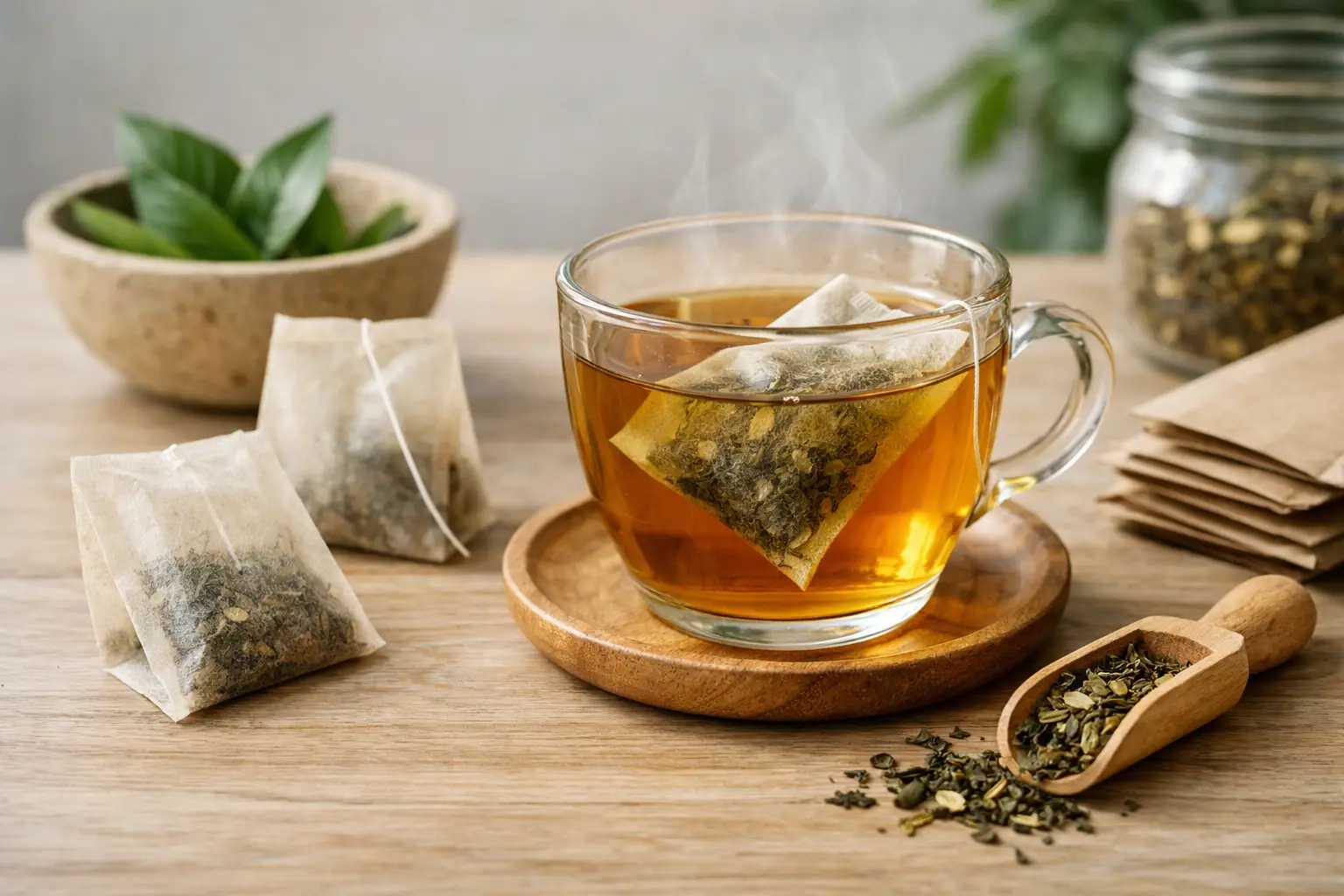
The first thing that touches the water is not the herb. It is the tea bag. And yet, when it comes to high-quality tea, this element is often left in the shadows. Biodegradable tea bags change exactly that perspective: they are not a packaging detail, but part of the experience itself, the purity in the cup and the responsibility behind every choice.
Why biodegradable tea bags matter
Scientific publications (2024-2026) from major research organizations confirm that tea bags—both plastic and many «paper» ones—release billions of microplastic and nanoplastic particles into the tea beverage.
Especially in the premium category, quality is not only judged by the origin of the herb or the intensity of the aroma. It is also judged by the medium that hosts it. A well-made infusion deserves a sachet that does not alter, does not weigh down, and does not contradict the naturalness of the contents.
For years, the market has been accustomed to sachets that emphasized convenience and low cost. This served mass consumption, but not the consumer who wants to know more about the product they are drinking. When you search Greek herbs organic farming, careful composition and refined taste, it makes sense to also look at the material that comes into direct contact with the beverage.
This is where the value of biodegradable solutions comes in. They express a more consistent philosophy: from nature to cup, with fewer compromises.
What does "biodegradable" really mean?«
The term sounds simple, but there is a distinction to be made. Not all bags are the same, and not every «green» claim is equally meaningful. Biodegradable means that the material can break down naturally under certain conditions. However, this does not automatically mean that it breaks down instantly everywhere and always.
Here we need to be honest. Some materials degrade faster, some require a more controlled environment. Some offer excellent extraction performance, some excel in durability. The right choice is not a matter of slogan, but of a balance between functionality, food contact safety and overall sustainability.
For the conscious consumer, this has practical significance. It is not enough to see a pretty sachet or an attractive word on the packaging. It is worth seeking clear information about the material, its use and how it contributes to the quality of the beverage.
The relationship between the sachet and the taste
In good tea, flavor is never isolated from form. A quality tea bag should allow space for the contents to develop, release aromas, and give full body to the infusion. That's why the premium pyramids they have established themselves as a choice with substance and not just aesthetic value.
When the herb is squeezed into a confined space, the extraction is usually poorer. But when it has room to move, the result in the cup is more vibrant. Mountain tea, verbena, chamomile or more complex herbal blends perform differently when the structure of the sachet allows the water to circulate properly.
Biodegradable tea bags, when designed properly, don't just serve sustainability. They also serve aroma. And that's perhaps the most essential criterion for anyone who doesn't see tea as a simple habit, but as a ritual of small daily pleasure.
How do they differ from conventional sachets?
The difference is not just in the environmental narrative. It is in the way the product is perceived as a whole. Conventional mass-market tea bags are often associated with lower-quality raw materials, highly chopped content, and a logic of quick, uniform consumption. They are the industrial version of tea: predictable, practical, but often flat.
In contrast, a premium biodegradable sachet is part of a more demanding experience. It usually accompanies whole leaves, selected herbs or more careful blends. The message is clear: the packaging is not there to cover up the weaknesses of the content, but to highlight it.
Of course, there is also the practical issue of cost. Better materials and more thoughtful packaging solutions raise the final price. This is a real trade-off. But for an audience that is not looking for the cheapest cup, but the purest and most authentic, this difference is often fully justified.
Biodegradable tea bags and premium hospitality
In the HORECA space, details speak louder than words. A hotel, restaurant or café with a clear gastronomic identity does not just offer a hot beverage. It offers image, care and consistency with the style of the space.
There, the tea bag takes on special weight. The visitor who sees an elegant pyramid with quality content and conscious choice of material immediately realizes that the experience has been curated. It is not just a sustainability statement. It is an indication of quality.
For hospitality professionals, the question is not just whether the product is beautiful or practical. It is whether it tells a story. Whether it conveys a place, a raw material and a point of view. At this level, a premium Greek concoction inside a biodegradable pyramid does not function as an accompaniment. It functions as a signature.
What to consider before choosing
If you want to evaluate a product beyond the nice words on the label, first look at its consistency. Is there a clear reference to the material of the sachet? Is it accompanied by raw materials of corresponding quality? Is there an identity of origin, or are we talking about a generic, vague product that is simply dressed up as ecological?;
Then, pay attention to the experience in the cup itself. Does the aroma come out clean? Does the herb open up? Does the result have intensity, duration, and a clean aftertaste? Sustainability without flavor content is half-baked. Just like premium aesthetics without real raw materials.
Finally, look at the philosophy behind the brand. The most interesting proposals in the category do not use biodegradable materials as an advertising ribbon. They integrate them into a broader approach that includes selected herbs, proper standardization, strong design and respect for the product from start to finish. Tea Odyssey also follows this logic, connecting Greek botanical heritage with a modern, sophisticated form of enjoyment.
The Greek dimension has a special value
When the contents of the sachet are Greek, the issue becomes even more interesting. The herbs of the Greek land have intensity, purity and recognizable character. They are not neutral raw materials. They carry landscape, altitude, sun, air and memory.
That is why the choice of biodegradable packaging acquires almost an ethical consequence. Such an authentic material demands a correspondingly careful way of presentation. The mountain tea, for example, is not just another herb on the shelf. It is an element of the Greek sensory identity. Serving it through a medium that respects both the taste and the philosophy of the product is part of its own value.
This does not mean that every biodegradable sachet is automatically superior. However, it does mean that, when combined with a serious selection of raw materials and a clear premium direction, it creates a more complete proposition. And it is this integration that stands out in everyday consumption, but also in high-demand hospitality.
A small change with a bigger footprint
Tea is one of the quietest pleasures. It is not imposed. It is not noisy. And yet, within this silent ritual, our choices tell us a lot. They say what we consider quality, what we call authentic, what we are willing to leave behind.
Biodegradable tea bags are not a fad for the shelf. They are a sign that the category is maturing and that a good product is no longer satisfied with just what its taste promises. It also takes care of how it reaches us.
If tea is more than just a hot beverage for you, it's worth starting where the extraction begins: from the teabag itself.


Pingback: Organic tea in pyramid bags — is it worth it? – tea odyssey… more than a tea a voyage
Pingback: Το μέλλον των αφεψημάτων έχει ελληνική ρίζα – tea odyssey… more than a tea a voyage