
For years, the café shelf has been filled with predictable choices. Same flavors, same words, same promise of quality that often never makes it to the cup. That's where the conversation about premium café drinks begins – not as another category, but as a different understanding of what enjoyment, raw material and hospitality experience mean.
For the modern consumer, the beverage is no longer just an accompaniment to espresso or a convenient alternative for non-coffee drinkers. It is a statement of taste. It is the moment when a store, hotel or home shows whether it is investing in the essential or settling for the conventional. And in this subtle but crucial distinction, the premium category immediately stands out.
What does premium café drinks really mean?
The term premium is often overused. In practice, however, an elegant packaging or a higher price is not enough. Premium is the beverage that starts from better raw materials, has a clean composition, a clear identity and a depth of flavor that is not exhausted in the first sip.
In the café space, this means that the accompanying or alternative beverage must stand equally in the face of the public's demand. If a customer pays attention to the origin of the coffee blend, the extraction and the acidity profile, they will hardly be satisfied with an indifferent tea, a flat chocolate or an iced drink lacking naturalness.
The premium logic, then, is not just about the product. It is about the overall care. From the selection of herbs and extracts to the presentation, the aroma, the purity of the aftertaste and how the drink fits into the style of a space.
Why premium café teas are gaining ground
The reason is simple. The public is tired of generic solutions. They are looking for beverages with provenance, narrative, and truth. They want to know what they are drinking and why it is worth more than a standardized mass-produced option.
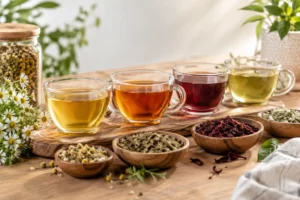
In Greece, this need also meets something deeper: the rediscovery of Greek herbs. Mountain tea, chamomile, sage, mint and other aromatic elements of the Greek land do not simply function as flavors. They convey memory, place and culture. When these are transformed into a modern premium proposal, the result acquires a depth that is not easily copied.
At the same time, the HORECA professionals have every reason to invest in this direction. A hotel or a café is no longer differentiated by its coffee alone. It is differentiated by its entire menu. By whether it offers a complete experience to those seeking something lighter, more natural or more refined during the day.
The difference lies in the raw material
This is where almost everything is judged. A premium tea beverage does not hide behind aromatic excesses or excessive sweetness. On the contrary, it relies on raw materials that have aromatic purity and character.
In herbal teas and herbal iced tea, this means real extracts, careful selection of herbs and a composition that does not sacrifice naturalness for an easy impression. Greek biodiversity offers a huge advantage here. Not only because it is recognizable, but because it has a flavor imprint with delicacy, freshness and duration.
There is, of course, the issue of consistency. A premium product should perform equally well every time. This applies to both the home consumer and the professional who needs reliable service results. Quality without consistency remains incomplete.
Pure composition is not a detail
When the public turns to better drinks, it's usually not just for the taste. It's also for the feeling of purity. It wants less pretentiousness, a cleaner label, a more honest relationship between what the packaging promises and what the product delivers.
That's why premium drinks stand out when they avoid the logic of sensationalism without substance. Instead of relying on cheap intensity, they opt for a more precise balance. This is often more difficult, but it is immediately noticeable.
From café to hotel – a new language of hospitality
In a hospitality space, every detail speaks. The glass, the aroma, the color, the story behind the product. Premium beverages don't just function as a catalog item. They function as part of the identity of the space.
A boutique hotel that serves carefully crafted herbal iced tea with a Greek botanical profile creates a different experience than a lodging that offers a generic, industrialized tea-type beverage. A café that gives space to authentically sourced teas opens a conversation with a more demanding, more conscious, and often more loyal audience.
This doesn't mean that every business needs an overly large range. Often, a few well-chosen codes perform better than a list without identity. The point is diligence, not quantity.
Premium is not the same for everyone
But there is a useful clarification. Premium does not mean the same thing in every channel. For the end consumer it can mean aesthetics, organic farming, biodegradable packaging and a more ritualistic everyday moment. For the professional it can also mean stability, ease of service, clear positioning on the menu and commercial value per serving.
The ideal proposal is one that manages to combine both. It should be culturally rich, but also functionally sound. It should have history, without losing its practical value.
The Greek signature makes the difference
In a market that often copies international trends without personality, Greek origin can become a real advantage. Not as a superficial label, but as authentic content.
Greek herbs have a recognizable character and are associated with a lifestyle that speaks of purity, light, moderation and natural pleasure. When properly translated into premium beverages, they create a proposition with international appeal and at the same time a deep local truth.
This is why companies like Tea Odyssey invest not only in taste, but also in the overall cultural value of the product. The beverage ceases to be just another SKU. It becomes a vehicle of place, design, and modern Greek hospitality.
How to choose premium coffee drinks correctly
The choice requires a little more attention than it initially seems. First, the raw material and the clarity of the composition are examined. Then, the taste behavior of the product: does it last or does it fade quickly? Is it natural or does it seem manufactured? Does it have its own personality or does it simply imitate something familiar?;
Then comes the question of application. One product works ideally in a modern all-day café and another in a hotel that wants a quiet, sophisticated identity. The consumer who drinks a hot beverage at home in the afternoon asks for one thing, and the visitor who seeks a premium cold serve without caffeine is another.
Packaging is also important. In the premium category, packaging is not just a wrapper. It is part of the experience and, increasingly, part of the ethics of the product. Biodegradable solutions, elegant presentation and thoughtful functionality substantially enhance the value.
When quality is seen and stays
The truly premium tea beverage doesn't try to shout. It wins with its calmness. With the purity of the aroma, with the balance of the taste, with the fact that it leaves a memory instead of a simple impression.
This is perhaps its biggest difference from conventional products. The latter often aim for quick consumption. The former create a relationship. And when a tea beverage manages to become part of the daily ritual or hospitality experience, then it does not only compete in its category. It becomes a point of reference.
For those building a more thoughtful beverage menu or a more substantial everyday selection, the question isn't whether there's room for better quality. The question is how clearly they want to express their taste through what they serve and what they choose to drink.