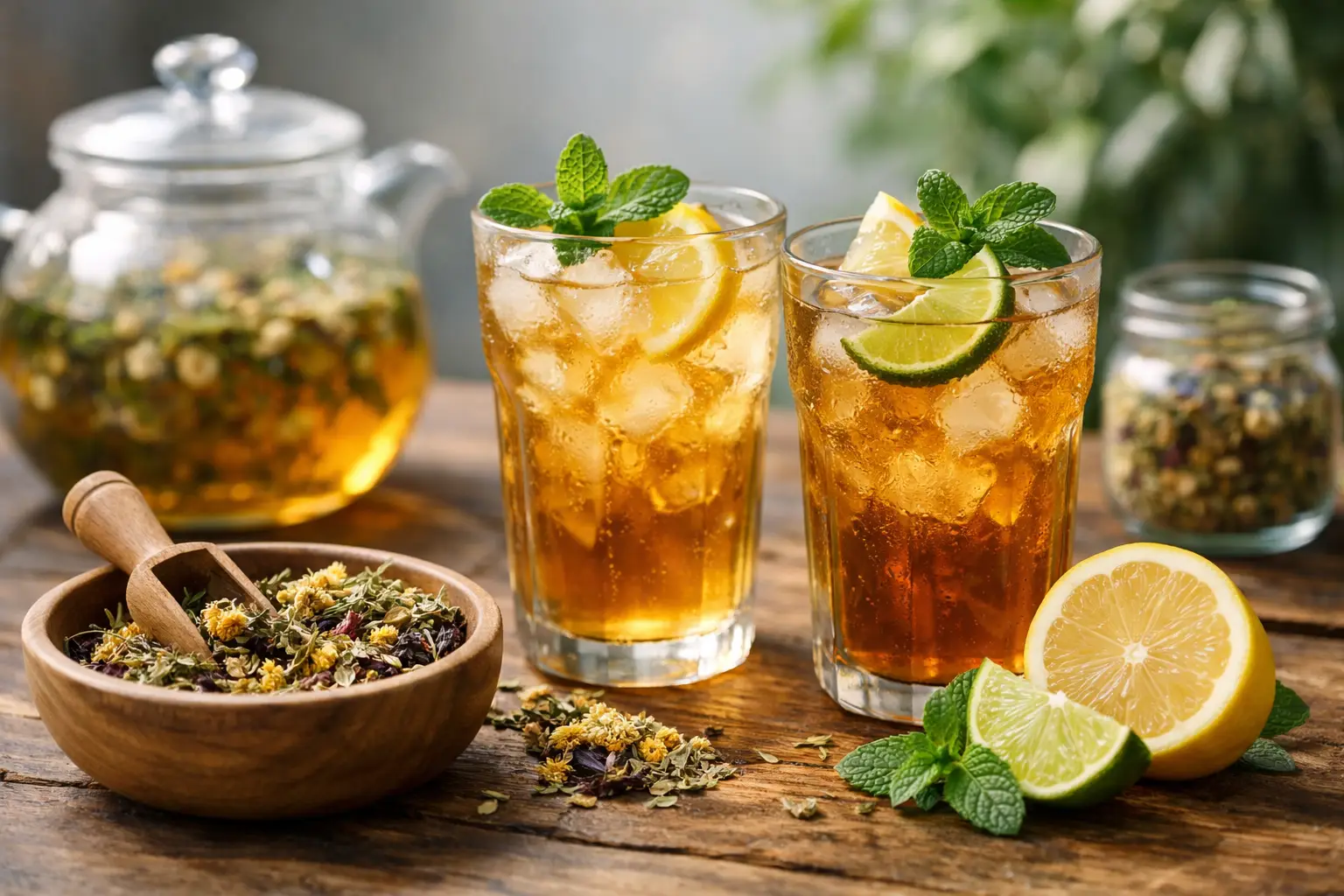
The first thing that stands out in a truly good herbal ice tea is not its sweetness, nor its color in the glass. It is the nose. That is where it is judged whether you have a drink with a real botanical soul or a simple, industrial impression of coolness. When we wonder how authentic herbal ice tea is made, the answer does not lie in a trick. It lies in the raw material, in the extraction method and, above all, in the philosophy that treats the herb as the protagonist and not as an aromatic footnote.
What does authentic herbal ice tea mean?
Authentic herbal ice tea doesn't just mean "cold herbal-flavored drink." It means the flavor comes from a real extract, from leaves, flowers, shoots, and fruits that have an identity, origin, and pure aromatic signature. The difference is substantial. Another drink that relies primarily on sugar, flavors, and acidulants, and another drink that starts with the herb itself.
In its premium version, herbal ice tea retains the character of the infusion even when served chilled. It is not flat, it is not aggressively flavored, it does not leave a taste fatigue. On the contrary, it delivers layers of flavor. An initial sensation of freshness, a botanical heart, a finish that remains clean.
That's why authenticity is not just an aesthetic issue. It is a technical and tasteful result.
How authentic herbal ice tea is made in practice
The process begins long before ice is added. It starts with the selection of herbs. Mountain tea, verbena, mint, sage, chamomile or hibiscus do not behave the same during extraction. Each herb has a different intensity, different aromatic volatility and different resistance to temperature. That is why good herbal ice teas are not built with an "all together" logic. They are built with precision.
The first step is the correct dosage. If there is too little herb, the effect comes out weak and is often corrected by excessive sweetening. If there is too much, the taste can become harsh, bitter or medicinal. Here lies one of the most common mistakes on the market. It tries to imitate the herbal character instead of extracting it properly.
Then comes the water temperature. Not all herbs need a long steeping. Some florals lose their delicacy when over-extracted. Others, like more woody or dense herbs, need more time to develop body. The authentic approach respects this difference. The goal is not to simply «pull out» color, but to convey character.
After extraction, the beverage needs rapid cooling or controlled cold stabilization. This point is crucial. If left for a long time at temperatures that tire the aromatic profile, herbal ice tea loses purity and begins to acquire a heavy aftertaste. Freshness is not just a feeling of consumption. It is the result of proper treatment.
The raw material is half the result
In an authentic herbal ice tea, the raw material is not hidden. It is seen and heard in the taste. Especially when we talk about Greek herbs, the origin is not a decorative element. It is part of the quality. Mountain tea, for example, has a clean, mountain feel, subtle but recognizable. It doesn't need exaggeration to stand out. It needs respect.
The same applies to the organic herbs. It is not enough to simply be certified. They must have been collected, dried and preserved in a way that keeps their aromatic charge alive. A tired herb cannot be saved by any technique. No matter how careful the preparation, the starting point determines the scope of the final result.
That's why truly premium drinks start with the care of the material. Not from the attempt to dress up something mediocre in a communication way.
Sweetness, acidity and balance
A common question is whether authentic herbal iced tea should be sweet. The answer is that it depends on the composition and the audience it is aimed at, but the sweetness should never overpower the herb. Its role is to balance, not dominate.
A slight sweet note can highlight mountain tea or soften the intensity of a more acidic element like hibiscus. But if the drink relies too much on sugar, then it loses its raison d'être. It ceases to be a botanical drink with personality and becomes a soft drink with a botanical reference.
The same goes for acidity. A little acidity gives nerve, brightness and freshness. Too much makes the profile one-dimensional. The goal is not to feel the lemon or the acidic element first. It is to feel that everything is tied together in a natural, calm intensity.
Why most iced teas aren't truly herbal
The market has accustomed the consumer to iced teas that often talk about nature, but taste far from it. Low content of real extract, aromas that are more reminiscent of promise than origin and excessive sweetness that flattens the delicate notes. This is the basic distance between the conventional and the authentic.
Authentic herbal iced tea doesn't need to shout. It doesn't rely on an artificial impression of intensity. It has calm, precision and purity. This, of course, means something else. That it's not always the easiest product to produce consistently and at scale. Natural extracts have variations. The raw material changes slightly from batch to batch. Standardization requires knowledge, not just a recipe.
That's exactly where the difference between a brand that functions as a curator of herbs and not as a manager of flavors can be seen.
The case of Greek herbs
Greece has a rare advantage in this category. It not only has a rich botanical tradition. It also has herbs with a strong sensory footprint, capable of supporting modern premium beverages without losing their authenticity.
Mountain tea is perhaps the most typical example. It does not have the tannicity of classic tea, so it can give a cleaner and smoother iced result. Verbena offers aromatic elegance. Mint gives immediate coolness, but needs moderation so as not to become one-dimensional. Sage has a more demanding character and needs proper balance to remain refined.
When these herbs are incorporated into a recipe with knowledge, they create something much more interesting than a simple summer drink. They create a modern Greek signature. A drink without gravity, but with a memory of place.
How to recognize a truly quality herbal ice tea
You don't have to be a professional taster to distinguish quality. Just notice three things. First, if the aroma is reminiscent of a natural herb and not an aromatic additive. Second, if the flavor has an evolution and not just a sweet first hit. And third, if the finish remains clean.
If after two sips you feel that the drink is making you tired, the balance has probably not been achieved. On the contrary, when a herbal iced tea It's well-made, it offers coolness without noise. It's refined but direct. Complex, without being difficult.
That's why authenticity is not a marketing issue. It's something the palate recognizes, even when it can't technically describe it.
From infusion to experience
Authentic herbal iced tea is not just a product category. It is a different way to think about the iced beverage. Less as a quick relief from the heat and more as a daily ritual of quality. On an urban lunchtime, on a hotel terrace, in a hospitality area who wants to say something more refined about his taste, the difference is immediately noticeable.
This is where a modern Greek proposal like “tea Odyssey” finds its place, treating herbs not as a trend but as a cultural and taste capital. And this is important, because premium is not judged only by appearance or packaging. It is judged by whether the content stands at the same height.
Ultimately, if we want to answer honestly how to make authentic herbal iced tea, the answer is simple but demanding. With real herbs, pure extraction, proper balance, and the maturity to let nature speak without unnecessary noise. That's where the real enjoyment begins – and that's where one usually returns.