

The aroma of mountain tea is not just a familiar Greek memory. It is the sensation of a hillside warmed by the sun, the air passing between rocks, and the patience it takes to harvest a plant at the right time. Greek herbs They have this rare ability: to transfer their place to the cup, without the need for complicated explanations.
For years, the herbal tea category was treated as a simple, «quiet» choice. Today, however, the way we choose what to drink has changed. We are looking for cleaner compositions, real raw materials, a taste with an identity and small daily rituals that have a reason for being. That is exactly where Greek herbs are located: between ancient knowledge of nature and a modern lifestyle that demands quality without excesses.
Why Greek herbs stand out
Greece is not a single botanical map. A plant that grows in mountainous terrain has a different character, a plant that receives the sea breeze, and a herb that grows in a dry, rocky landscape have a different character. The altitude, the microclimate, the composition of the soil and the rhythm of the seasons shape the aroma, the intensity and the duration of the taste of each harvest.
This geographical polyphony explains why mountain tea can be floral and soft, but at the same time leave a distinctive, almost honeyed aftertaste. Why sage has a clean, lively presence. Why verbena brings a bright, lemony trace, while chamomile remains the most tender version of calm.
It is not enough, however, for a package to say «herbs.» Origin is only the beginning. Quality is judged by when the plant was cut, how it was dried, how it was preserved, and how faithfully its natural aromas reach the cup or glass. A decoction made from whole, carefully selected plant parts has a different purity than a powder of unknown composition or a beverage based mainly on aromas and sweeteners.
From collection to taste
The journey of an herb is part of its value. Harvesting at the right time determines its aromatic richness, while gentle drying helps preserve the plant's character without being altered by excessive heat. Then comes the selection: leaves, flowers and tender stems require attention, because detail is what separates a flat drink from a vibrant experience.
Organic farming and responsible harvesting are of particular importance in this process. They are not just an indication on the packaging. They are linked to respect for the soil, the consistency of the raw material and the ability to enjoy an herb in the purest possible expression.
There is also a practical side. Proper packaging protects delicate aromas from moisture, light and air. Biodegradable pyramids, when containing quality herbs, allow the plant parts to grow in the water. This way, the extraction becomes more complete and the flavor gains depth instead of being rushed and weak.
The value of simplicity
The best herbal teas don't need to hide their nature. A well-crafted blend can rely on a few ingredients, as long as each one has a reason to be present. Mountain tea can stand alone with admirable confidence. But it can also be paired with verbena for more freshness or chamomile for a rounder, softer feel.
Balance is the key. A too-strong herb can overwhelm the rest, while an overly complex blend often loses its clear voice. Curating a good blend is like curating a small collection: nothing is superfluous and nothing is loud enough.
Hot tea or herbal ice tea?;
Season shouldn't limit our relationship with herbs. In winter, a warm infusion gives space for the aromas to slowly unfold and invites a pause. In summer, the same raw material can be transformed into a sophisticated iced drink with a clean, refreshing character.
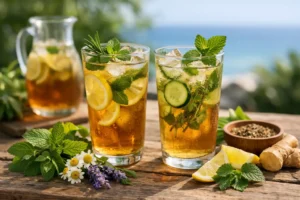
Here lies a fundamental difference between herbal ice tea and regular ice tea. iced tea The latter often relies on sweetness, aromas, or a minimal amount of actual extract. A premium herbal iced tea, on the other hand, starts with the same question we ask for a hot beverage: what herb do we want to “hear” and how do we preserve its natural presence in the glass?;
The answer is not always the same. Those who prefer a more intense sweetness may take time to appreciate a cleaner, less loaded recipe. But it is precisely this subtlety that allows the herb to shine through. The sweetness doesn’t have to mask the flavor. It can make it clearer.
A ritual that fits into everyday life
Preparing a herbal tea is a small act of care, not a complicated process. The water doesn’t always need to boil aggressively, especially when it comes to delicate flowers and leaves. A few minutes of patience is enough to give the herb space to express itself. If we leave it too long, the flavor can become harsher. If we rush, we will lose its subtle nuances.
For a cold version, a strong brew that is gradually cooled and served with ice more faithfully preserves the character of the herbs than a rough dilution. A slice of lemon or a mint leaf can work nicely, but they are not necessary. When the raw material is good, it does not need staging.
This philosophy is at the core of Tea Odyssey: Greek organic herbs, with a special place for mountain tea, in forms that respect both everyday convenience and taste truth. From biodegradable pyramids to ready-made herbal ice teas, the intention remains the same: the drink should not just be a thirst quencher, but a small wander through the Greek land.
Choosing based on origin
The label is worth a few seconds of attention. Look for clear reference to the herbs the product contains, their origin, and how they are presented. The transparency in composition It is a sign of respect for the consumer. The same applies to packaging that protects the contents and reduces unnecessary footprint.
Above all, trust your taste. Greek herbs are not a nostalgic image on a shelf. They are a living language of aromas, with different dialects from mountain to mountain and from season to season. Let your next mug or next frosty glass remind you that quality often starts with something simple: a plant, a place and the time to get to know them.


Pingback: How to make authentic herbal ice tea – tea odyssey… more than a tea a voyage
Pingback: How long does bottled infusion last in the fridge; – tea odyssey… more than a tea a voyage
Pingback: How to store tea properly at home – tea odyssey… more than a tea a voyage