
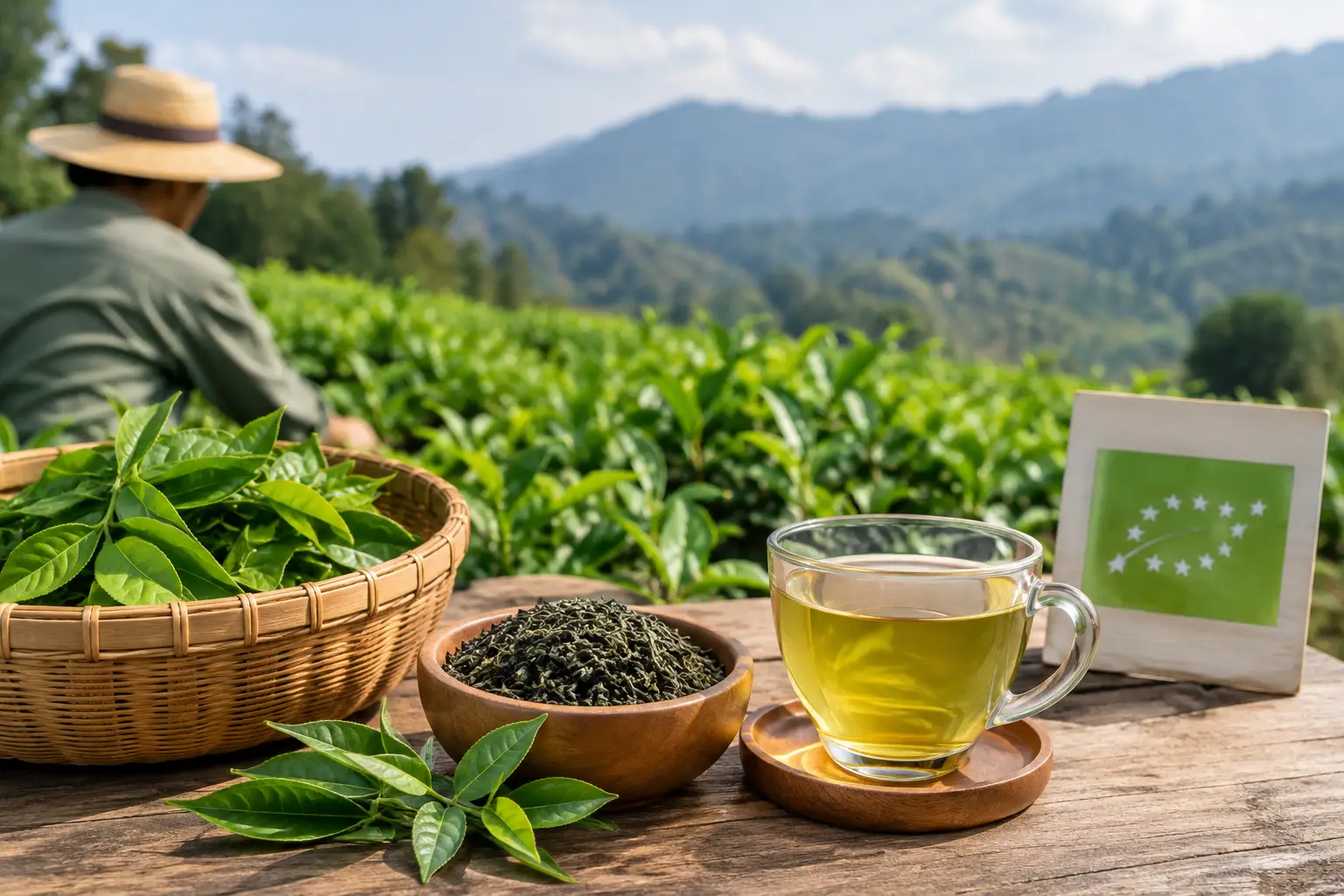
The aroma of mountain tea does not begin in the cup. It begins in the soil, in the care of cultivation, in the moment of harvesting, and in every choice that intervenes until the herb reaches the label. A biological tea certification guide is not just about a green label on the packaging. It’s about proving that the raw material’s journey is clean, controllable, and worthy of the taste it promises.
For a herb producer, a standardizer, or a premium brand of infusions, certification turns origin into a documented value. For the consumer and the HORECA professional, it becomes a practical way to distinguish the real extract, the carefully selected raw material, and transparency from general promises.
What is actually certified in organic tea
In the Greek market, the term ‘tea’ is often used for herbal infusions, such as mountain tea, lemon balm, sage, or chamomile. Botanically, these are not the classic tea from the Camellia sinensis plant. However, certification logic is common: every ingredient declared as organic must have been produced, processed, stored, and distributed within a controlled chain.
Certification examines cultivation, permitted inputs, avoidance of non-permitted pesticides, storage, standardization, and traceability. It’s not enough for the field to be organic. If the product is mixed, packaged, or distributed without proper procedures, its organic declaration cannot stand.
This distinction is particularly important in blends. A herbal infusion with Greek herbs, peels, spices, or aromatic substances requires control for each individual ingredient. Premium quality is not built with vague descriptions. It’s built when you know what each batch contains and can prove it.
Organic tea certification guide in six stages
1. Choose your role in the chain
The process begins with a simple but crucial question: do you cultivate, collect, dry, mix, package, or trade? Each activity affects the certification field. A cultivator has different obligations than a company that buys organic herbs and converts them into tea pyramids or ready-to-drink herbal ice tea.
If a business does more than one stage, it must declare them accurately. Transparency here prevents delays, incorrect labels, and costly corrections when the product is already ready for the market.
2. Collaborate with an approved control body
The certification body is the independent controller of the process. The business submits an application, describes facilities, products, and activities, and is included in a control program according to the applicable European framework for organic products.
It’s not a relationship that’s only activated before printing the packaging. It involves initial control and repeated inspections, and may also provide for additional checks. Proper planning is essential, especially when a new harvest or launch has a specific commercial schedule.
3. Build a traceability file before you need it
Traceability is the quiet power behind an organic product. For each batch, it must be clear where it came from, when it was received, in what quantity, how it was stored, if it was used in a mix, and in what final batch it ended up.
In practice, this means organized purchase receipts, supplier certificates, batch codes, production records, and inventory logs. It’s not bureaucracy for bureaucracy’s sake. If a HORECA customer requests documentation or an inspection arises, the business must be able to narrate the product’s journey without gaps.
4. Protect the product from contamination and confusion
The warehouse and production line are just as important as the field. Organic and conventional raw materials must be clearly separated, either spatially or temporally, with documented equipment cleaning and clear labeling.
The detail gains weight in small units, where the same space serves different products. Closed containers, readable codes, and disciplined reception procedures reduce the risk. The organic herb is worth maintaining not only its certification but also the aroma, color, and cleanliness that make it unique.
5. Check the recipes, not just the herbs
In a blend or a ready-to-drink beverage, control extends to all ingredients: extracts, juices, sweeteners, acids, flavors, and any auxiliary substance that participates in the recipe. The word ‘natural’ doesn’t automatically mean ‘organic’, nor does one organic herb suffice to characterize the entire product as organic.
Here, collaboration is needed between the product development team, suppliers, and the control body. Every recipe change, even if it seems small, must be evaluated before it goes into production. This is particularly critical in herbal ice tea, where the authenticity of the extract must match the accuracy of the composition.
6. Approve the label before it’s printed
The label is where certification meets the consumer. References to organic production, product name, control body code, and the European logo where required must be used correctly and only when covered by certification.
Attention is also needed in indicating the origin of agricultural raw materials. Greek origin is a strong promise, especially when the product is based on local herbs. However, it must be accurately reflected and supported by the corresponding evidence. The label is not a decorative surface. It’s a brief statement of responsibility.
The conversion period and difficult cases
For a conventional cultivation that wants to switch to organic farming, a conversion period is usually required. During this time, organic practices are applied, but the product cannot necessarily be marketed as fully organic. The exact duration depends on the type of cultivation, the history of the plot, and the instructions of the certification body.
More complex is the case of wild harvesting. Wild Greek herbs have a unique character, but their organic reference requires documentation of the area, assessment of potential pollution sources, and a collection method that respects the plant’s regeneration. ‘Wild’ is not automatically organic. However, when collection is done with knowledge and measure, the value of local flora is highlighted in a substantial way.
Certification as part of the premium experience
Organic certification does not replace taste. An infusion can be certified and yet be bland, old, or hastily designed. Conversely, an excellent herb without a documented chain cannot legally bear its organic identity. True excellence is born when quality and control move together.
This is why Tea Odyssey approaches Greek herbs as raw material with cultural depth and not as just another ingredient. From the biodegradable pyramid to the refreshing herbal ice tea, the experience becomes more convincing when packaging, composition, and origin speak the same language.
For the producer, certification can open the door to more demanding collaborations and export markets. For a cafe, hotel, or restaurant, it offers a product with a clear history that’s worth serving and explaining. And for the person holding the cup, it gives a reason to trust that behind the aroma, there is care.
The most correct next move is not to rush to put the word ‘organic’ on the label. It’s to map your own journey, batch by batch, and let certification confirm what your product already wants to say: that quality has a place, time, and truth.


