
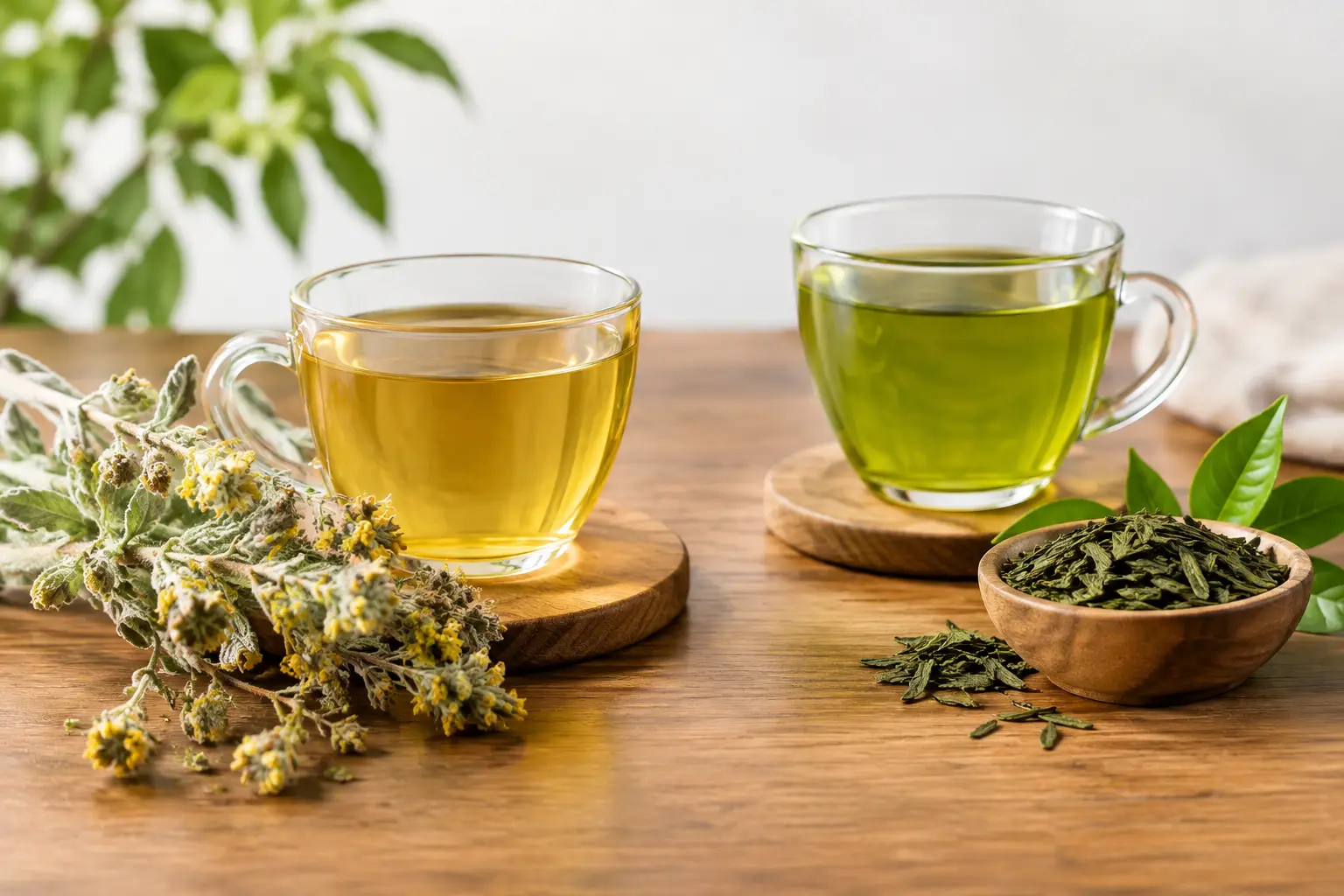
The question «mountain tea or green» is not simply about two options in the cupboard. It concerns two different paths of taste, origin, and rhythm. On one hand, the aromatic austerity of the Greek mountains. On the other, the vegetal intensity and the long ritual of the East. There is no single right answer — there is the beverage that best serves your own moment.
Mountain tea or green: two different raw materials
The first essential difference lies in the plant itself. Mountain tea comes from the genus Sideritis, a herb that thrives in the mountainous regions of Greece and the Mediterranean. Its flowering stems are collected, carefully dried, and yield an infusion with a golden color, a discreet aroma, and a clean, botanical character.
Green tea, by contrast, comes from Camellia sinensis, the same plant that gives us black, white, or oolong tea. Its difference lies in how the leaves are processed: oxidation is limited, so as to preserve the green appearance, the vegetal freshness, and its characteristic intensity.
The distinction is not formal. It explains why the two beverages have a different relationship with the time of day, the water temperature, and the taste expectation. One is a Greek herb and naturally caffeine-free. The other is true tea, with a natural caffeine content.
Their taste speaks a different language
Mountain tea evokes clean air, dry grasses warmed in the sun, and floral notes, with a soft earthy aftertaste. It is a gentle beverage, without the aggressiveness of bitterness, that leaves room for the nose and the palate. It can stand on its own, with a few drops of lemon or with honey, without losing its identity.
Green tea has more nerve. Depending on its variety and origin, it can deliver grassy, marine, nutty, or lightly astringent notes. When brewed correctly, it is elegant and lively. But when the water is too hot or the steeping time too long, the bitterness can cover its delicate nuances.
Here there is no winner. Anyone seeking a soft, bright, and easy-to-drink daily cup will often turn to mountain tea. Anyone desiring more vegetal intensity and a slightly tonic sensation will most likely prefer green tea.
Caffeine changes the moment
Mountain tea does not naturally contain caffeine. This property makes it particularly versatile: it can accompany a quiet breakfast, be offered after a meal, or become a warm evening habit without carrying the intensity of a stimulant beverage.
Green tea contains caffeine, usually less than a coffee, but enough that the experience is not the same for everyone. The amount is influenced by the variety, the quality of the leaves, the dosage, the temperature, and the steeping time. For many it is a balanced choice for breakfast or early afternoon. For those sensitive to caffeine, the time of consumption needs more attention.
If the goal is a beverage that fits any hour, mountain tea has a clear advantage. If you are seeking a ritual that awakens the senses without the power of an espresso, green tea has its own place.
Origin is part of the taste
In a premium beverage, origin is not decorative information on the packaging. It is part of the experience. Greek mountain tea carries the microclimate of the mountainous places, the slow growth of the plant, and the traditional knowledge of its harvest. Its quality shows when the stems are whole, when the aroma is clean, and when the raw material has not been flattened into colorless powder.
In green tea, origin is equally decisive. A leaf from Japan, China, or Korea can express a completely different profile. The harvest season, the cultivation, and the processing alter the taste to a degree that recalls the way a wine changes from place to place.
For the conscious consumer, the choice should not begin from a general promise of wellness. It begins from the purity of the composition, the recognizable origin, and respect for the raw material. An authentic infusion does not need excessive flavorings or much sugar to acquire interest.
How to prepare them without losing their character
Mountain tea loves hot water and time. With water close to boiling and a few minutes of steeping, its flowers and stems gradually open their aroma. It can also be gently boiled, a practice familiar in Greek tradition, as long as it does not stay on the fire for too long.
Green tea wants greater precision. Water that has rested a little after boiling, around 70–80°C, and a short steeping time are usually enough. Patience here does not mean more time. It means the right temperature, so as to preserve its freshness without astringent edges.
Both can be served cold, but with a different logic. Mountain tea gives a light, Mediterranean iced infusion that pairs beautifully with citrus or herbs. Green tea offers a livelier, sharper result. The difference becomes even clearer when the beverage is not covered by sweeteners.
When to choose mountain tea and when green
Choose mountain tea when you want calm without giving up flavor. It is the natural choice for the home, for a gathering that needs warmth, or for a cool, botanical break during the day. Its Greek identity also makes it particularly suited to hospitality spaces that want to offer guests something with a real place behind it.
Choose green tea when the day calls for concentration and clear intensity. It suits morning working hours, a light meal, or moments when you are seeking a more structured taste profile. It is not, however, always the ideal evening choice, particularly for those who avoid caffeine.
The most interesting answer to «mountain tea or green» may ultimately be «both,» but not with the same role. Green tea for alertness. Mountain tea for the pause. The first brings discipline to the routine, the second brings place and breath.
At tea Odyssey, mountain tea is treated exactly this way: not as a nostalgic habit, but as a modern Greek raw material with a place in a more refined everyday life. Choosing a beverage can be a small act, but when it has a clear origin and true taste, it becomes a personal journey.
So keep space for both in your cupboard. And next time, do not wonder which is «better.» Ask what the moment needs: the green alertness of a leaf or the golden quiet of a Greek mountain.