The first sip of a properly prepared mountain tea does not merely remind one of herbs. It evokes the clean air of a mountain slope, sunlight on stone, and that simple generosity of the Greek landscape that needs no effort to stand out. It is a deeply familiar drink, yet not a given one. When the raw material is carefully selected, the origin pure, and the infusion correct, it transforms into an experience with character.
For years, mountain tea held a steady place in Greek homes: a warm cup for cold days, a simple ritual of care. Today, it reclaims its rightful place in modern kitchens, hotels, cafés, and tables seeking flavor with identity. Not as a nostalgic remnant, but as a refined, authentically Greek choice for every season.
What exactly is mountain tea?
Although we call it tea, mountain tea does not come from the Camellia sinensis plant, like black or green tea. It is an infusion made from plants of the Sideritis genus, which thrive in the mountainous regions of Greece and the wider Mediterranean. Its name is almost a map of origin: its value is tied to altitude, microclimate, soil, and the pace at which the plant develops.
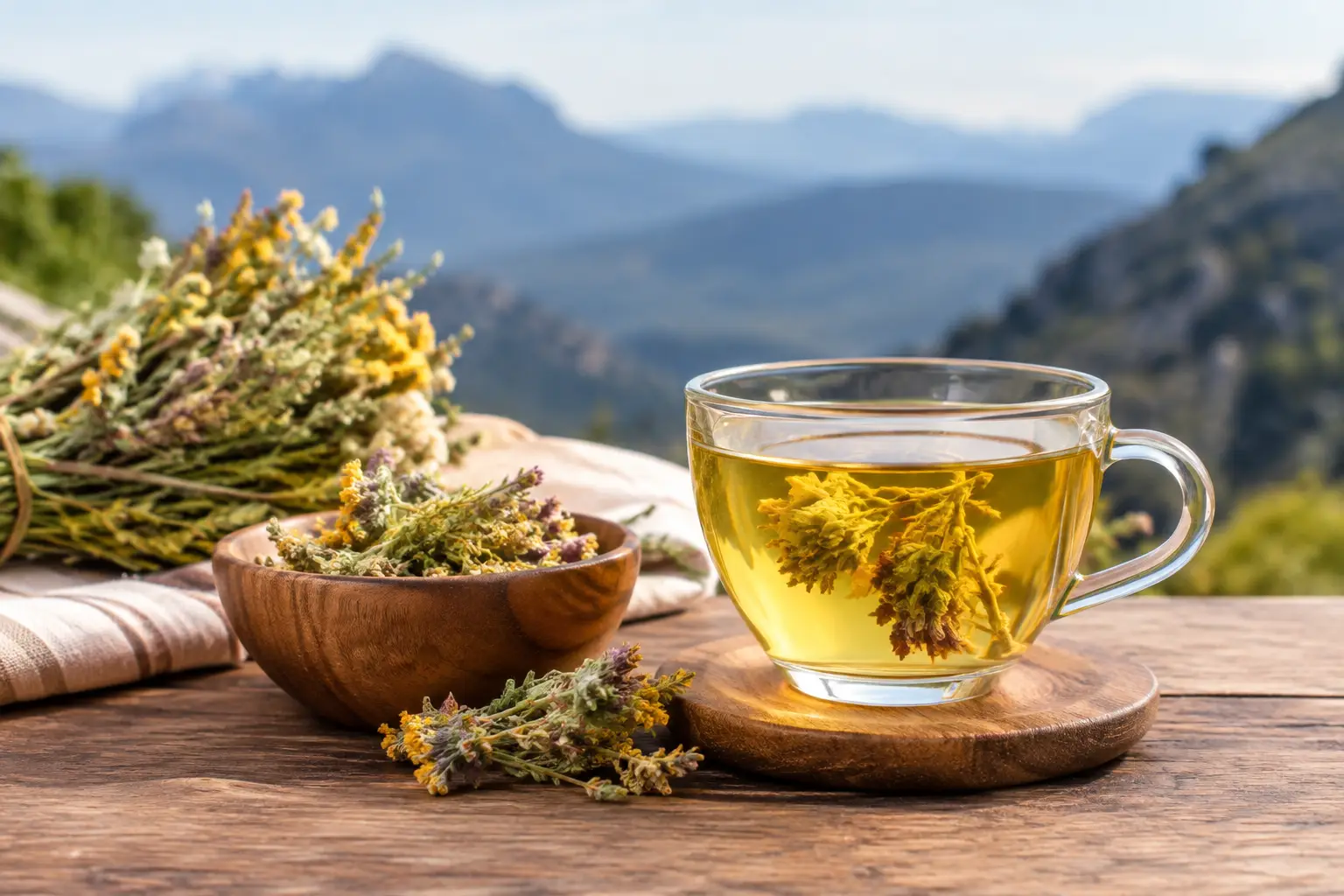
The flowering stems, leaves, and flowers yield a soft, golden infusion with an earthy aroma, herbal hues, and a delicate sweetness. It does not pursue the intensity of coffee nor the tannic rigor of a strong black tea. Its charm lies in its purity and balance.
This is precisely why quality is not hidden. In a good infusion, the herb retains its visual integrity and releases aromas that are lively, not flat or dusty. The difference shows in the cup, but it begins much earlier: at harvest, during gentle drying, and through careful standardization.
From the mountain slope to the cup
Origin is not merely a label to complete a package. For Greek herbs, it is an essential part of the flavor. The significant temperature fluctuations, sunlight exposure, and poor, rocky soils of mountainous areas contribute to the aromatic character of the plant. Each cultivation has its own subtle variations, just as a wine expresses its place and vintage.
Organic cultivation adds yet another dimension of choice. It is not simply a signal responding to the need for cleaner raw materials. It is a direction that respects the plant’s cycle and the landscape that gives it birth. For the consumer, this translates into greater transparency. For the hospitality professional, into a story that has depth and can be offered with pride.
Authenticity, however, also requires precision. An herb that has been exposed too long to light, moisture, or air loses part of its aromatic intensity. That is why packaging is not a secondary detail. It protects the contents, facilitates proper dosing, and ultimately determines how closely the plant’s original expression will reach the cup.
Whole herb or faceless powder?
In the category of infusions, appearance says a lot. Visible pieces of leaves, flowers, and stems offer an initial sign of care, while allowing for a more gradual extraction. In contrast, an overly powdered mixture may release color quickly, but often lacks the complexity and purity that one seeks.
This does not mean that every finely ground herb is inferior, or that every large piece guarantees an excellent result. Quality is judged holistically: in the cleanliness of the material, its freshness, proper storage, and the balance of the recipe. Yet, when the herb has room to breathe, the tasting experience often becomes more generous.
How the flavor is brought out
Mountain tea is easy to prepare, as long as one does not rush. For a warm infusion, the water should be fresh and clean. Once it reaches a boil, let the herb steep for a few minutes, typically between 5 to 8, depending on the quantity and intensity desired. In this way, the herbal and earthy notes emerge without being masked by excessive heat or prolonged extraction.
Sweetening is not necessary. Honey can add a warm, Greek dimension, especially during winter months, but it is worth trying the infusion plain first. You will more clearly perceive its gentle natural sweetness and subtle herbal nuances.
For a chilled drink, the method requires intention. Prepare a more concentrated infusion, let it come to room temperature, and then chill it. Ice dilutes the flavor, so a slightly more intense base is the key. A strip of lemon zest, a few drops of citrus, or a sprig of mint can accompany it without stealing the herb’s leading role.
Here lies the real difference from many conventional iced teas. When flavor is built upon a genuine infusion of Greek herbs, it does not need to rely on excessive sweetness or aromatic overkill. The result has lightness, a clean finish, and a reason for being at the table beyond mere thirst.
Hot or cold? Mountain tea does not choose the season
The warm cup remains the most familiar version of all. It suits low-light mornings, afternoon pauses, and a quiet close to the day. Since it contains no caffeine, it is also an option for those who want an evening drink without the stimulating intensity of coffee or classic tea.
Summer, however, reveals a different self. Chilled, it becomes refreshing and light, with an aromatic personality that does not resemble a soft drink. In the kitchen, it can stand beside light dishes, fruits, honey-based desserts, or even a hotel breakfast looking to offer something beyond the expected choices.
For HORECA spaces, this versatility is invaluable. A well-presented infusion adds Greek character to the guest experience without becoming folklore. It can be served in a design hotel, a modern brunch spot, or a restaurant choosing local ingredients with a contemporary eye. Its story is immediate, yet its impression lingers.
Small choices that change the experience
Quality in the cup is not a matter of ceremony for the sake of ceremony. It is the result of simple, conscious decisions: to choose herbs with clear origin, to pay attention to the blend, and not to treat packaging as something indifferent. Biodegradable pyramids, for example, combine convenience with room for the herb to develop, while expressing a more responsible relationship with daily consumption.
Tea Odyssey approaches this tradition as a modern Greek proposal: with organic herbs, careful standardization, and emphasis on infusions and herbal ice teas that let the raw material speak. This is not a return to the past. It is a new reading of it, with aesthetics, precision, and respect for flavor.
Mountain tea is worth keeping close, not only for the days when you seek comfort. It is worth it as a small daily reminder that place can travel, as long as we let it express itself purely.