
At 07:30, before the breakfast room fills with voices and suitcases, the hotel breakfast has already articulated a promise. In the pastries, the fruits, the coffee, but also in the small choices that often seem secondary, the guest reads what kind of hospitality awaits them. This hotel breakfast case study examines how tea and Greek herbs can transform a familiar buffet into a place experience.
It is not about adding yet another code to a tray. It is about a more substantial choice: to give the breakfast a voice, origin, and memory. When a guest tries mountain tea, lemon verbena, or sage, they are not simply receiving a hot drink. They encounter a piece of Greek land, presented with care.
The starting point: a proper buffet without a distinct character
Let’s look at a representative 4-star hotel in an island destination, with an international audience and high occupancy from spring to autumn. Its breakfast was adequate: good variety of food, careful presentation, and organized operation. In the beverages, however, the experience remained standard.
There were conventional tea bags of unclear origin, few expected flavors, and ready-made iced tea that looked more like a sweet soft drink than an expression of leaves or herbs. The guests did not complain. But neither did they photograph it, nor ask about it, nor remember this side of the breakfast when they returned home.
Here lies a basic truth of hospitality: the absence of complaints is not necessarily an indication of value. For hotels seeking higher perceived quality, simply avoiding mistakes is not enough. They need to create small, clear moments of pleasure.
Hotel breakfast case study: changing the offering
The new approach did not start from the question «which tea should we put?». It started from «what do we want the guest to remember?». The answer was a morning experience of Greek origin, modern and light, without folklore and without unnecessary noise.
The solution was based on three distinct moments. The first was the hot infusion corner, with biodegradable pyramids of Greek herbs. The second was the chilled premium herbal ice tea option, particularly useful for high-temperature months and for guests who do not drink coffee. The third was the storytelling: small, aesthetically pleasing labels that explained in simple words the herb, the origin, and the way to enjoy it.
Mountain tea was placed at the center. Not as an exotic attraction, but as the pure, authentic choice it is. Beside it, lemon verbena offered aromatic freshness and sage a more herbal, earthy tone. The variety was sufficient to cover different preferences, without making the station look confusing or overloaded.
Tea Odyssey can serve exactly this logic: Greek organic herbs, premium presentation, and an offering designed both for the aesthetics of the buffet and for the daily operation of HORECA.
Why pyramids change the perception
Form matters. A biodegradable pyramid does not only function practically, allowing the herbs to infuse better in the water. Visually, it communicates greater care immediately than an anonymous, flat tea bag. The guest sees the contents, recognizes the raw material, and realizes that the hotel did not simply choose the cheapest solution.
This does not mean that every property needs dozens of options or a ceremonial tea station. In a boutique hotel, three carefully selected flavors may be more convincing than twelve unconnected codes. In a large resort, conversely, a wider range might better serve different nationalities and peak hours. The right choice depends on the type of guest, seasonality, and available space.
Herbal ice tea as a morning option, not as a substitute
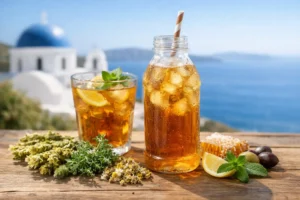
In summer destinations, the need for something cool appears early. There, premium herbal ice tea takes on a role that goes beyond the conventional logic of «iced tea». With a real herbal identity and a cleaner taste profile, it can stand beside juices and fruit water as an adult, refined option.
The difference is critical. A product with excessive sweetness tires the palate and often cancels out the promise of a well-crafted breakfast. A herbal ice tea that highlights Greek herb extracts adds coolness without looking like yet another standardized soft drink. At the same time, it gives the hotel a substantial option for guests seeking caffeine-free alternatives or simply wanting something different from juice.
What changed in the guest experience
The most interesting results of such an intervention are not reflected only in numbers. They are reflected in behavior. Guests stand a little longer at the beverage station. They ask what mountain tea is. They consciously choose a cold herbal drink before leaving for the beach. They share an image of the breakfast not because the buffet is excessive, but because it is special.
For the hotel, this value has many dimensions. First, the sense of locality is enhanced without needing to change the entire menu. Second, the premium image becomes more consistent: a design hotel or an accommodation with an authentic Greek identity does not leave the beverage looking like an afterthought. Third, material arises for the reception and service team, which can speak to the guest with a simple, true story.
There is also a functional benefit. When the offering is clearly organized, staff do not need complex instructions. They need correct placement, steady replenishment, clean vessels, and knowledge of two or three basic phrases for each herb. Luxury in breakfast is not born from excess. It is born from consistency in detail.
The mistakes that reduce value
The quality of the raw material can easily be lost if the presentation does not support it. The first mistake is placing premium infusions next to plastic cups or makeshift signs. The second is serving the herbal ice tea without proper cooling, to the point where it looks like a random fridge product. The third is the lack of information: without reference to Greek herbs, the difference remains invisible to a large part of the audience.
Equally problematic is excessive staging. The guest does not need a large text to understand the value. They need a short description, a clear name, and a presentation worthy of the product. Authenticity does not shout. It has confidence.
From breakfast to the overall hospitality identity
A successful hotel breakfast does not end at the last sip. It can continue in the lobby, at the pool bar, at the welcome moment, or even as a small departure gift. Repeating the same quality thread at different moments makes the experience more cohesive and the hotel brand more recognizable.
The choice of Greek herbs has particular power because it unites the local with the global. The international guest immediately understands the value of origin, while the Greek guest recognizes something familiar in a more modern, refined version. It is not a general «wellness» idea. It is taste with geography.
For the next breakfast you design, look beyond the coffee and pastries. Ask yourself which small sip could make the guest stop, ask, and take with them a true memory of Greece.